
Oct 13, 2026
Brent Crude at $125.44/bbl, Up 10% on the Week
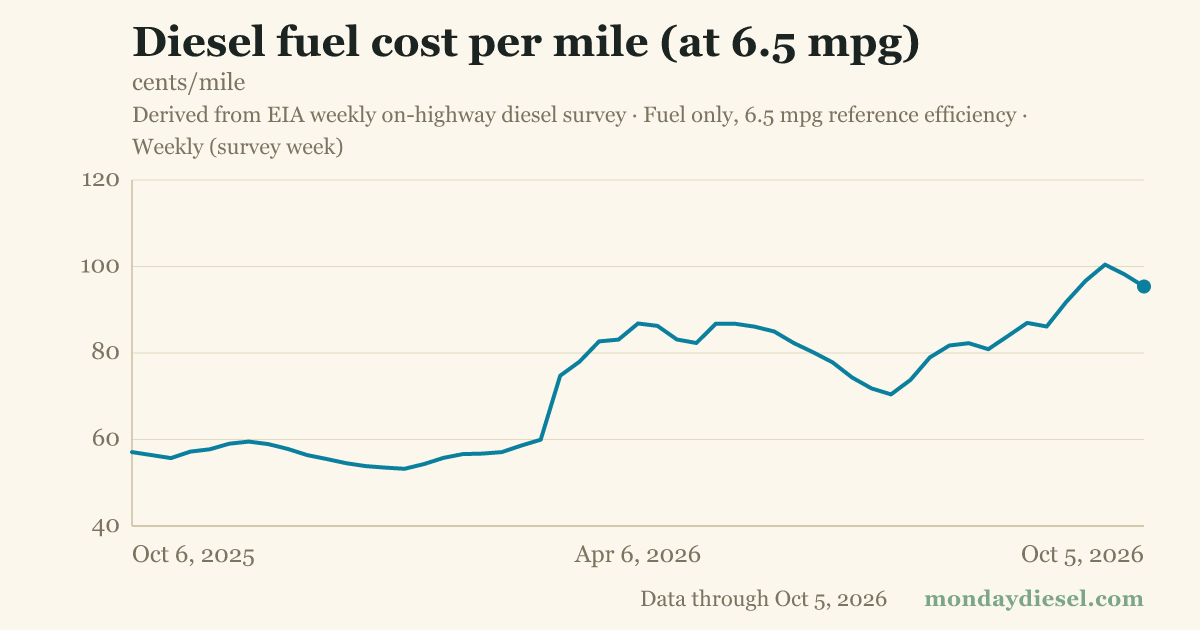
The DOE diesel index is $6.199/gal for the week of Oct 5, down 18.3 cents. At the stated 6.5 mpg reference, that is 95.4 cents a mile. Brent crude jumped 10.1% on the week to $125.44/bbl, 53% above the five-year median.
Numbers as of Oct 13, 2026 pull
Cite
The Monday number, the morning it posts
Get Monday Diesel in your inbox every Tuesday. No spam, we won't ever share your email, and you can always unsubscribe.
The DOE number for the week of 2026-10-05 is $6.199/gal, down 18.3 cents on the week, per EIA's weekly on-highway diesel price survey. At the stated 6.5 mpg reference, that is 95.4 cents a mile of fuel cost. The week's move trims about $14.08 from the cost of a 500-mile haul.
- Brent crude (Europe spot): $125.44/bbl as of Oct 6, up 10.1% week over week, per EIA's daily spot series. At 53% above the five-year median, Brent is the week's largest percentage mover across all series tracked here.
- WTI crude (Cushing spot): $96.24/bbl as of Oct 6, up 0.1% week over week and 24% above the five-year median, per EIA's daily spot series. Over the DOE survey week itself, WTI fell $3.24/bbl from $99.37/bbl to $96.13/bbl before recovering to near-flat by Oct 6.
- Crude vs pump, same span: The DOE number fell 18.3 cents while WTI dropped $3.24/bbl over the week ending Oct 5. Crude is roughly half the cost of a gallon at the pump and reaches it with a lag of days to weeks.
- West Coast vs Gulf Coast: The West Coast (PADD 5) at $7.229/gal sits 141.0 cents/gal over the Gulf Coast (PADD 3) at $5.819/gal, per EIA's weekly on-highway survey.
- Seasonal position: AAA Oregon/Idaho's Marie Dodds said Oct 6 that pump prices remain the highest on record for this time of year. The DOE number enters peak fall harvest trucking demand season with back-to-back weeks of declines.
Gulf Coast ULSD spot was $4.510/gal on Oct 5 and $4.565/gal on Oct 6, per EIA's daily spot series. New York Harbor ULSD was $4.713/gal on Oct 6. The US pump at $6.199/gal sits $1.689/gal over the Oct 5 Gulf Coast spot level. That gap includes fuel taxes and the full distribution layer. It is a retail-layer proxy, not a station margin.